
Meet OpenAI's Newest Models: O3 and O4 Mini
In 2025, OpenAI introduced two powerful additions to its AI lineup: O3 and O4 Mini. These next-gen models push the boundaries of what’s possible with AI. They reason more like humans, understand multiple types of input (text, images, and more), and use external tools dynamically to get things done. Alongside them, OpenAI also launched GPT-4.1.
What’s a “reasoning” model? It’s a type of AI that doesn’t just generate answers - it breaks down complex problems, figures out the steps needed to solve them, and decides when to bring in extra help, like a web browser or Python. Say you give it a photo of a research paper - it can zoom in on charts, read the text, search for related work online, and give you a clear, well-informed explanation.
O3, O4 Mini, and GPT-4.1: What’s the Difference?
Let’s clear up some confusion. GPT-4.1 is currently only available via API, meaning you can’t use it inside ChatGPT just yet. That will likely change down the road.
Now here’s where it gets exciting: O3 and O4 Mini are agent-like models. They don’t just wait for instructions. They choose - on their own - when to use tools and how to approach a task. And they don’t wait until the end of a thought to use those tools; they use them as part of the reasoning process, like a human solving a problem step by step. These models were trained with tool use in mind, which means they didn’t just learn "how" to use tools - they learned "when" it makes sense to use them.
They’re also more robust than previous models. They resist jailbreak attempts, handle malicious prompts more gracefully, and perform more reliably in real-world scenarios. The result? Smoother, more natural responses that adapt to your context.
Smarter Training, Better Results
O3 and O4 Mini were trained with significantly more computational power than earlier models. They also get more time to think through problems during inference. This lets them produce better answers - especially on tasks that require careful reasoning. In short, more time to think means better performance.
They can also be customized via API and extended with user-defined tools, not just the standard ones like browsing, Python, file handling, or image processing.
Eventually, we may see these names unified under the GPT-5 umbrella - but that’s still speculation. What we do know is that on April 30, 2025, the older GPT-4 model will be removed from the ChatGPT interface. It’ll still be available through the API, but not in the main app.
How They Perform in Benchmarks
O3 scores impressively across math, coding, and image-based tasks - outperforming the older O1 model by a wide margin. It’s a powerful model, but it also comes with a higher API cost.
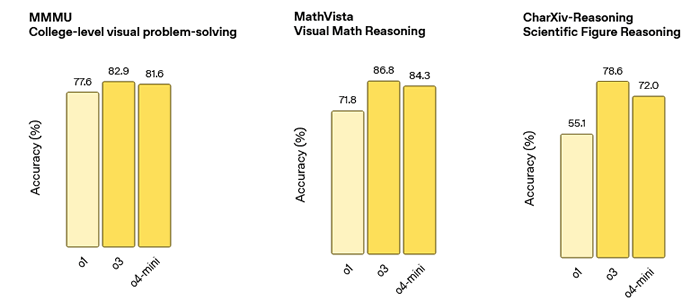
O4 Mini offers a great balance: it’s cheaper, faster, and still extremely capable. On the AIME 2025 benchmark (with Python tools), it hit 99.5% pass@1 and 100% consensus@8. O3 came close behind at 98.4%, proving its strength in high-level math tasks. O4 Mini even outperforms O3 in non-STEM benchmarks, showing strong results in data analysis, business tasks, writing, and creative problem-solving.
Redefining What AI Can Do
With O3 and O4 Mini, OpenAI is changing the way we interact with AI. These models don’t just give answers - they think. Tools aren’t just extras - they’re part of the thought process. And software development is starting to feel more like “vibe coding”: creative, fast, intuitive.
The future of AI isn’t coming. It’s already here - and it’s thinking in real time.


