
What Is Loop Engineering?
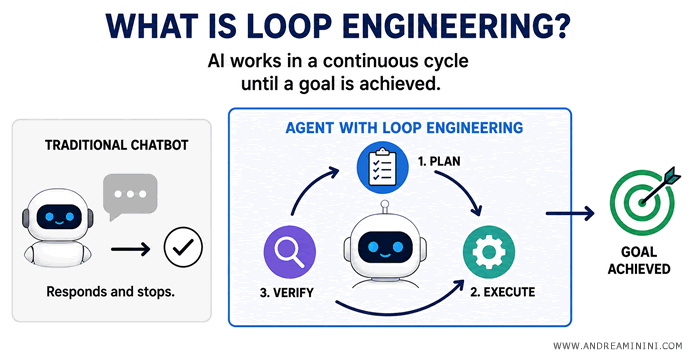
Loop engineering is the practice of designing AI workflows in which an agent continues working until it reaches a clearly defined goal.
Unlike a traditional chatbot, which responds to a request and then stops, an AI agent can work through an iterative cycle of planning, action, evaluation, and improvement.
The quality of the final result depends not only on the initial prompt, but also on how effectively the entire workflow has been designed.
Why a Prompt Is No Longer Enough
For years, using artificial intelligence mainly meant writing a prompt, reviewing the response, and refining the request when necessary.
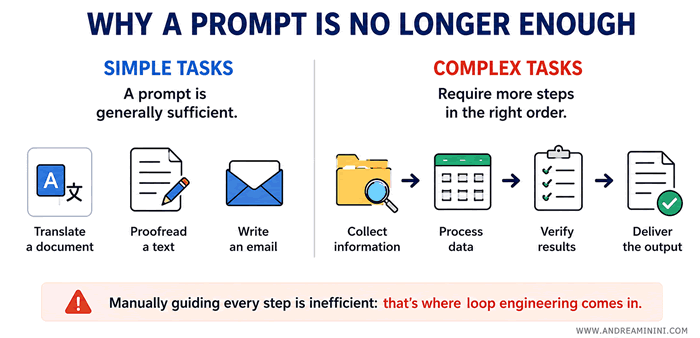
This approach works well when a task is simple or can be completed in a single interaction.
For example, translating a document, proofreading a text, or drafting a short email can usually be handled with a single prompt and response. In cases like these, a prompt is often all you need.
Many real-world tasks, however, are far more complex.
Consider preparing technical documentation, updating a company knowledge base, or producing recurring reports. These activities involve more than generating a single answer. They require a series of coordinated steps that must be completed in the correct order.
Managing every stage manually soon becomes inefficient. Loop engineering solves this problem by turning the work into an iterative process that an AI agent can carry out with a defined level of autonomy.
The Goal of Loop Engineering
The purpose of loop engineering is not simply to write longer or more sophisticated prompts. Its real goal is to design a workflow that allows an AI agent to complete a task autonomously while remaining within clearly defined boundaries.
The human user sets the objective, provides access to the necessary tools and information, and establishes the rules the agent must follow.
The agent can then plan its work, perform the required actions, evaluate intermediate results, and adjust its behavior when it encounters missing information, errors, or unexpected outcomes.
This changes the user's role. Instead of directing every individual step, the user designs, supervises, and improves the workflow as a whole.
How an Agent Loop Works
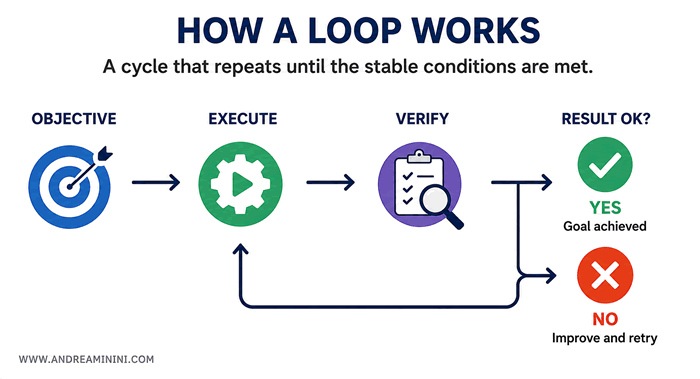
An agent loop is a repeated cycle of actions and evaluations. The agent starts with a goal, performs one or more tasks, examines the outcome, and decides whether the objective has been achieved or whether more work is needed.
If the result is incomplete or incorrect, the agent can revise its plan, choose a different action, or repeat specific steps.
The cycle continues until the success criteria are met or a termination condition is reached.
The key feature of an agent loop is iteration guided by feedback.
Rather than producing a single response, the agent repeatedly plans, acts, evaluates, and improves its work until it reaches the required standard or is instructed to stop.
A Practical Example
Imagine a company that prepares an internal news briefing every morning.
A conventional chatbot could summarize a set of articles provided by a user.
An agentic system, however, could manage the entire workflow.
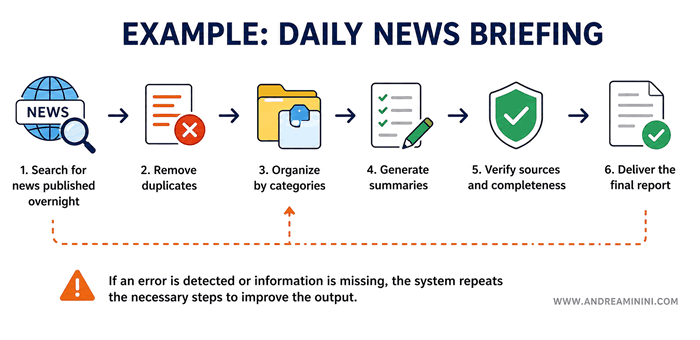
It could search for news published overnight, remove duplicate stories, organize articles by topic, generate concise summaries, check that all required sources are included, and create a report ready for distribution.
If a source is unavailable or an expected category is missing, the system could change its search strategy, consult alternative sources, or repeat selected steps before completing the report.
This ongoing cycle of choosing actions, using tools, evaluating results, and deciding what to do next is the agent loop.
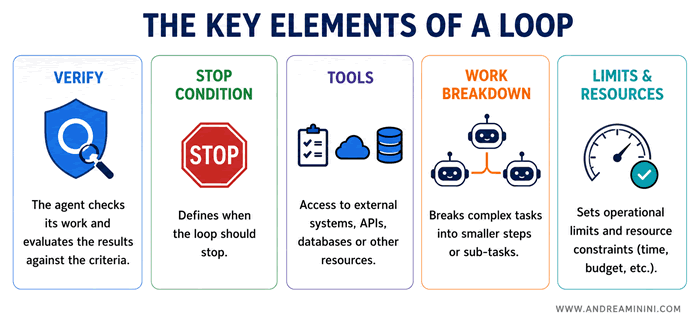
Evaluation Is at the Heart of the Loop
An agent loop is only reliable if the system can evaluate the quality of its own work.
Every workflow therefore needs clear evaluation criteria.
The agent must be able to determine whether the result is complete, whether it meets the required standards, and whether any essential information is missing.
Evaluation can be based on fixed rules, validation tools, automated tests, reference data, external services, human review, or another language model acting as an evaluator.
Without an evaluation stage, the agent cannot reliably distinguish a correct result from an incomplete or incorrect one. This can lead to poor-quality outputs, repeated failures, wasted resources, or an infinite loop.
Evaluation provides the feedback the agent needs to improve its work with each new iteration.
When Should the Loop Stop?
Every loop needs one or more termination conditions. These conditions define when the task has been completed or when continuing is no longer useful.
The agent must know exactly when to stop.
For example, the workflow may end after every document has been processed, all required fields have been completed, or every validation check has passed. It may also stop after reaching a maximum number of iterations, exceeding a predefined resource limit, or encountering an error that cannot be resolved. For example: after x attempts, stop and return the best result obtained so far. A time limit can also be used. For example: return the best available answer within 5 minutes.
These safeguards prevent the system from wasting time, computing power, or API resources by repeating the same actions indefinitely.
The Role of Tools
An AI agent can perform only the actions supported by the tools and resources available to it.
Designing an agent loop therefore means deciding which external systems the agent can access and what it is allowed to do with them.
These resources may include internal documents, databases, APIs, search engines, cloud services, software platforms, or enterprise applications.
As the workflow becomes more complex, reliable integration with these tools becomes increasingly important.
The agent does not operate in isolation. It works as one part of a broader software system.
Breaking Complex Problems into Smaller Tasks
A single agent is not always the best solution. In more advanced workflows, different responsibilities may be assigned to several specialized agents.
For example, when preparing technical documentation, one agent may collect the necessary information, another may verify the accuracy and consistency of the data, and a third may review the clarity, structure, and quality of the final document.
Each agent focuses on a specific role, while an orchestrator or supervisor agent coordinates the entire workflow.
This type of architecture is commonly known as a multi-agent system. It can make complex tasks easier to manage through specialization and parallel processing.
However, multi-agent systems also create new challenges, including coordination overhead, communication failures, duplicated work, inconsistent decisions, and higher computational costs.
For this reason, multiple agents should be used only when their benefits clearly justify the added complexity.
The principle of "divide and conquer" still applies, but the solution should not become more difficult to manage than the original problem.
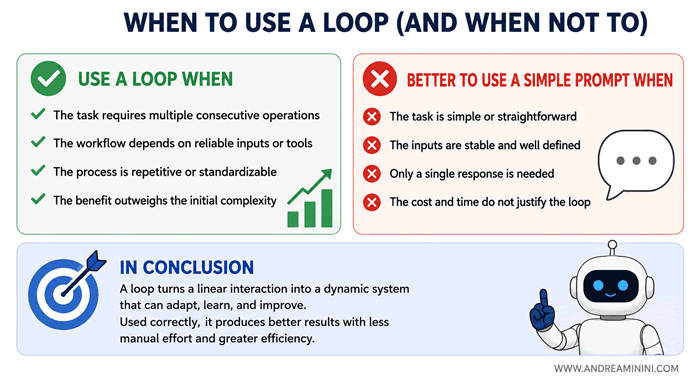
When Should You Use Loop Engineering?
Loop engineering is especially useful for tasks that require several consecutive actions and whose progress can be measured against clear criteria.
It is also well suited to recurring workflows that follow the same overall process while handling different inputs each time.
Designing, testing, and validating the workflow may require a significant initial investment. Once the system is in place, however, it can often be reused many times with limited human intervention.
Agent loops are particularly valuable when the system needs to interact with external tools, adapt its strategy based on intermediate results, recover from predictable errors, or make decisions as new information becomes available.
When Is a Simple Prompt the Better Choice?
Not every task requires an agentic workflow.
For tasks such as obtaining a definition, proofreading a document, translating a text, summarizing a short article, or generating ideas, a single prompt is usually enough.
Building an agent loop for these activities would introduce unnecessary complexity, longer response times, higher costs, and additional points of failure.
The right solution depends on the nature of the task. The longer, more repetitive, more dependent on external tools, and more objectively verifiable the workflow is, the greater the potential value of loop engineering.
Conclusion
Loop engineering represents an important shift in the way artificial intelligence systems are designed and used.
The focus moves away from individual prompts and toward complete workflows built to achieve clearly defined goals.
Creating an effective agent loop requires more than an understanding of large language models. It also requires a clear understanding of the process being automated, reliable evaluation criteria, well-integrated tools, explicit constraints, effective error-handling procedures, and carefully designed termination conditions.
Monitoring, security, observability, traceability, and human oversight are equally important, especially when agents interact with external systems or perform actions that can have real-world consequences.
When these elements are designed properly, artificial intelligence can do more than assist users with isolated tasks. It can carry out complete workflows with a controlled level of autonomy while maintaining predictable behavior, measurable quality, and effective oversight throughout the process.


